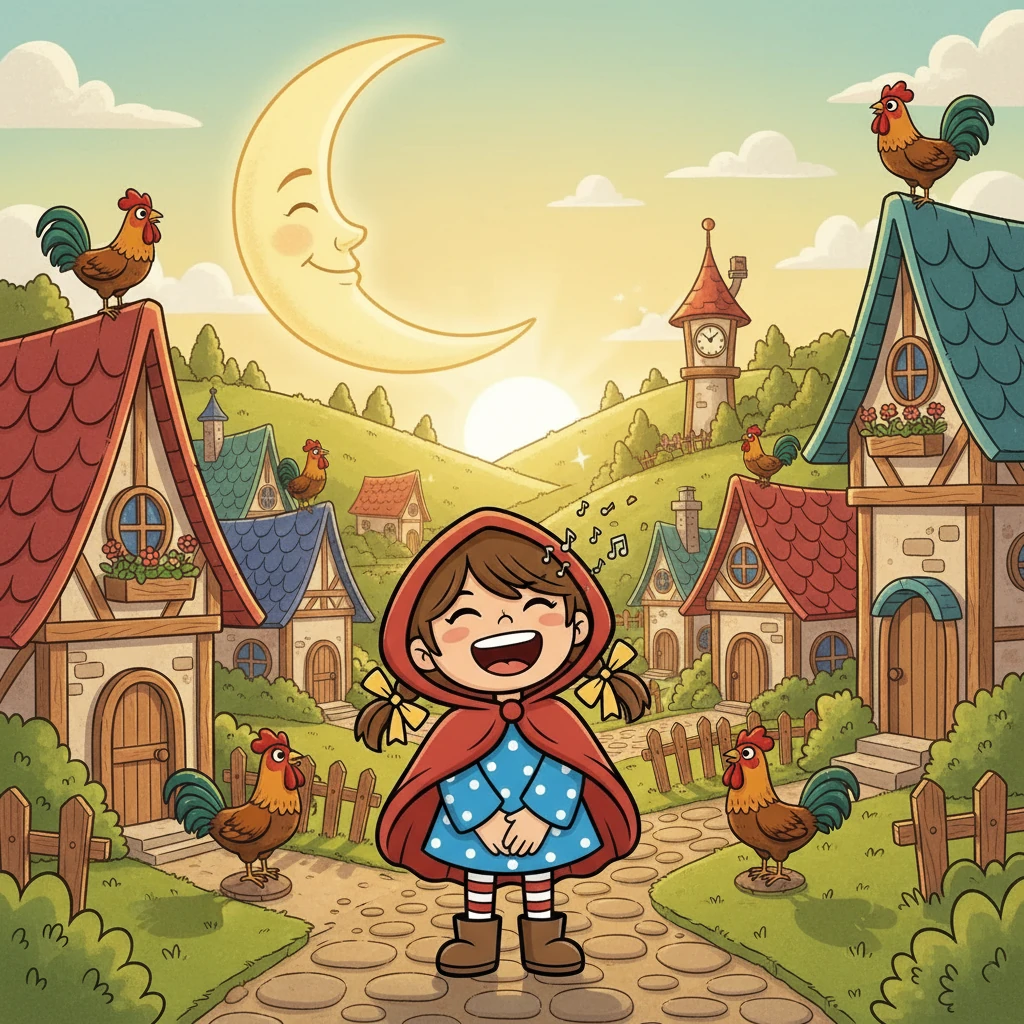
Join Little Red on a magical journey where rhythm is the key to saving her village from a mysterious silence! This enchanting story celebrates the power of music, courage, and the bonds of family, reminding us that even the smallest voice can make the biggest difference. A heartwarming tale perfect for children and adults alike.
语言:英文
发布日期:
分类:童话故事
阅读时间:4 分钟
关键词
Little Redrhythmdawnvillagewolfdancemusiccouragegrandmotherstory
生成提示词
In a quiet crescent-shaped village where the moon often lingered even after sunrise, there lived a girl known as Little Red. She was called that not for her cloak — though she wore one, bright as cinnamon and soft as sunrise — but because she was always the first light to appear in people’s lives. She smiled early, rose early, and even the elders said that her laughter could wake the roosters before dawn. Her grandmother, Ballerina Cappucina, was a legend in her youth. Long ago, she had danced on the marble floors of distant cities, her pirouettes so graceful they made even fountains freeze mid-splash. But she had returned to this little village by the forest, bringing with her a love of coffee, rhythm, and gentle mornings. In her cottage, the scent of roasted beans mixed with the melody of her old gramophone. Every night, before bed, Cappucina would tell Red stories about rhythm and courage — how music could protect the soul, how dance could heal silence, and how the world itself spun on rhythm: the heartbeat, the tides, the prayers at dawn. And every morning, the village woke not to alarms or bells, but to the soft beating of the sahur drum — “Tung… tung… tung… sahur!” It was the rhythm that called people to wake before sunrise, to eat, to prepare for fasting, to remember gratitude. But one night, a strange mist crawled from the forest — thicker than fog, colder than breath. The moon hid behind clouds, and the next morning, the sahur call never came. The villagers slept on. The air was too quiet, as if someone had muted the sky itself. Red woke instinctively. She could not explain why — perhaps her grandmother’s old rhythms still pulsed in her dreams. She looked out her window and saw the drummer boy’s lantern still hanging by the well. The drum lay beside it, torn. And in the distance — faintly, like a whisper — she heard a low hum. A growl. She wrapped herself in her cloak, packed her basket with a small thermos of coffee, and slipped into the forest. The forest was different at this hour. The usual songbirds were silent. Even the wind seemed to hold its breath. The path was narrow, lined with trees like tall, watchful giants. As she walked, she tapped her foot to keep courage — tung, tung, tung, soft as a heartbeat. Halfway down the trail, she met an old figure cloaked in shadows. “Where are you off to, little girl?” the voice purred. “To wake the drummer boy,” Red said, not stopping. “You won’t find him awake,” the voice said again, and from the shadows emerged the Wolf — not a beast of fur and fang, but one of whispers and smoke. His eyes gleamed silver like spilled moonlight. “He sleeps now. They all do. Isn’t the silence peaceful?” Red clutched her basket tighter. “Peaceful isn’t the same as good,” she said. The Wolf tilted his head. “Ah, but peace is what people ask for, isn’t it? I only gave it to them. No noise, no waking, no hunger.” “You took their rhythm,” Red whispered. The Wolf smiled. “And soon I’ll take yours.” Before he could step closer, Red took a deep breath and remembered her grandmother’s words: “When fear tries to hush you, dance your rhythm louder.” She untied her cloak and let it fall like a curtain on a stage. Then, barefoot on the cold earth, she began to move. At first, her steps were timid — one, two, three. Her toes brushed the leaves, her arms curved like the crescent moon. The forest watched. Even the Wolf paused, curious. Then came the rhythm. Her feet struck the ground — tung, tung, tung! Her cloak swirled. Her breath matched the beat. She spun once, twice, thrice — tung tung tung sahur! The ground trembled lightly, not with fear but with awakening. A lantern flickered somewhere beyond the trees. Then another. The dawn’s first call of a rooster broke through the dark. The Wolf howled, covering his ears. “Stop that noise!” But Red didn’t stop. Her dance grew stronger, faster, brighter. She danced the rhythm of her grandmother’s coffee whisk, of the drummer boy’s heartbeat, of every morning that refused to stay asleep. Her steps were drums, her arms were bells, her cloak was sunrise. The Wolf’s smoke began to thin. His silver eyes dulled. “No,” he gasped, “silence was safer…” Red leapt, spun, and landed on the last beat — TUNG! Light burst from her cloak. The Wolf vanished into the mist, carried away by the rhythm he couldn’t silence. When Red opened her eyes, the forest had changed. The mist was gone. Birds sang again. The drummer boy, who had been sleeping under a tree, awoke, rubbing his eyes. His drum was whole again. He looked at her in awe. “Did you… save the sahur?” Red smiled and handed him the thermos from her basket. “No. We both did. Now drink some coffee and start drumming.” He grinned, lifted his drum, and began — tung, tung, tung, sahur! The sound rolled through the village like a heartbeat. Lights turned on, mothers prepared food, fathers whispered prayers, children stirred from dreams. When Red returned home, her grandmother was already waiting at the door, her silver hair shining in the dawn light. “You danced it back, didn’t you?” she said softly. Red nodded. “You taught me the rhythm.” Ballerina Cappucina hugged her and whispered, “Then the rhythm lives on.” And ever since that morning, when the sahur drums echo through the village, the people say they can still hear a faint, graceful sound between the beats — a dancer’s footsteps, light as dawn, brave as music. Tung… tung… tung… sahur. Tap… spin… step… dawn. And thus, Little Red became not just a girl with a cloak — but the guardian of rhythm, the keeper of mornings, and the granddaughter of the Ballerina who taught the world to wake with grace.